jueves, 10 de febrero de 2011

Victoria; I think it's worth to go there on holidays and learn their traditions.
I would like to try their food and meet with their people.I have some friends and I recommend that Uruguayans will say it's worth visiting and enjoy the party how they lives .
Mateo; For me Christmas in Uruguay is one of the most special days for the Uruguayan people, is when you feel the love of people out all the street and spend all day together. At night dinner shooting firecrackers and 12 and the next day all the children out to play with the gifts that Santa Claus left. 5 years ago that I returned to my country and the country misses the cultures and the affection of the people.
Devora ;
I would like to try their food and meet with their people.I have some friends and I recommend that Uruguayans will say it's worth visiting and enjoy the party how they lives .
Mateo; For me Christmas in Uruguay is one of the most special days for the Uruguayan people, is when you feel the love of people out all the street and spend all day together. At night dinner shooting firecrackers and 12 and the next day all the children out to play with the gifts that Santa Claus left. 5 years ago that I returned to my country and the country misses the cultures and the affection of the people.
Devora ;
my opinion about Christmas in Uruguay are not very different than they would say they are in Chile, in the form of celebration is much like the time to celebrate with family and friends.
Vasily ; I think that in Uruguay should go, because there are very cheerful people that have great traditions. I especially liked the tradition in which they poured the water out of the window at people (New Year)
it's great fun .
sábado, 15 de enero de 2011
Christmas in Uruguay
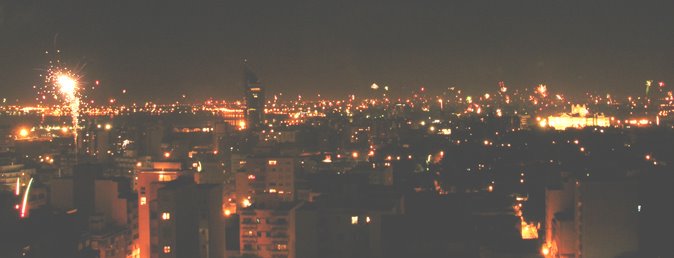 First of all, there is no such a thing as white Christmas in Uruguay, for two reasons. The first one is that in this hemisphere is summer time, the second being that it never snows in Uruguay.
Santa Claus here is called Papa Noel, and his associates here deliver all the Christmas presents at 12’ o clock sharp. Children want to reach 12 in the night to get their presents and have fun. Yes, yes, HoHoHO!
There are no Christmas vacations, school period goes from March till December.
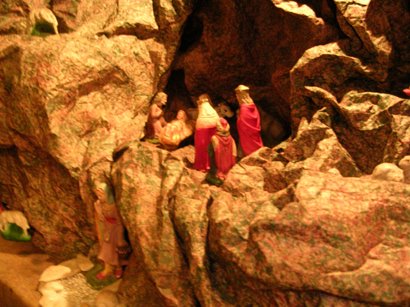 Preparations for Christmas’ eve and Christmas day include setting up your own Christmas tree. Another thing to do is to make one little holy manger usually within the fireplace, with ceramic figures, and rock paper. Some families also leave the little Jesus spot empty in the manger until Christmas day arrives.
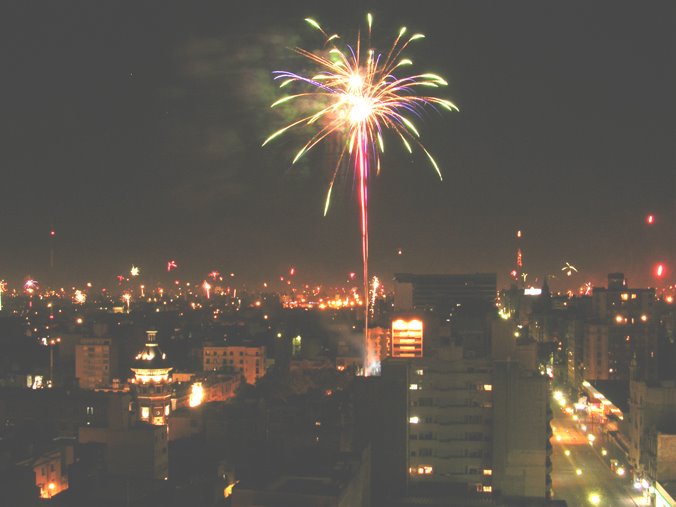
Christmas is celebrated typically in the following manner: families gather on a Christmas’s eve dinner, spend the evening together, until the clock ticks twelve. When Christmas day finally does arrive, everyone hugs each other, parents put up a children’s deceiving show telling them to look at some nonexistent star in the sky. While the children look to the sky hoping to see Santa Claus, parents try to put some gifts under the Christmas tree without being seen, relatives with children are looking at the stars trying to distract the kids so parents are not seen, throwing rockets entertain them or making them games.
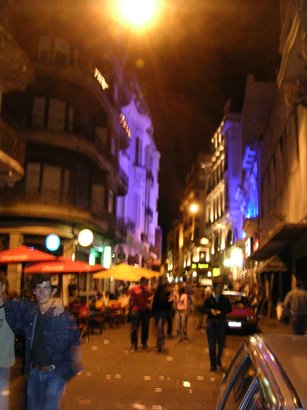 After all of this in Montevideo the two more interesting spots to be are “La Rambla” where people usually park their cars and put music real loud, dancing and drinking by the beach, or in ciudad vieja where there are a lot of pubs to hang out.
 By the way... HAPPY CHRISTMAS!!! FELIZ NAVIDAD!!

viernes, 22 de octubre de 2010
Interesting facts about Uruguay:1. In Uruguay, free medical care, even for tourists, but you just pay one doctor - dentist.2. In Uruguay, very friendly people - if you ask them the way, you still most likely hold to your destination.3. Uruguay is a reading nation - the number of bookstores here are very large.4. It is not strange, but almost 90 percent of the representatives of the European race.5. Uruguay - one of the few countries that has won the World Cup, and did it twice.6. In Uruguay, was only the World Cup within a single city - Montevideo.7. Uruguay - One of the most economically developed countries in Latin America. However, for the Uruguayan economy characterized by a permanent combination of ups and downs, surges of inflation. In Uruguay, the most evenly distributed in Latin America, revenues, because Uruguay is often called the "Switzerland of Latin America"
alsoWhen our countryman for the first time goes to Uruguay, then it especially affects the following:1) friendly people. If you ask for directions, not only to count how many quarters to this point, but will part ways. Do not say, for example, about Argentina or Moscow.2) Tea, mate. Every third passer in his hands is a special cup for a mate and a thermos under his arm, from a cup now and then sipped.3) overt emotion. Russia After the Cold fact that the buses passed applaud wandering singers may seem strange.4) The natural laziness. Well, this feature is quite close to us.5) High civilized country. Name of Uruguay can not be considered to be very successful in terms of perception. Sounds like a cannibalistic tribe. However, when you get into the country, one wonders that the Internet cafes in each house, wifi and gprs are developed in exactly the same as in Moscow, the same McDonald's on every corner, foreign cars, buses and so on.6) A clear regulation of all. Uruguay has not, unlike Russia, for example, oil feed, can be so all there is zvoy law or decree of the government.7) The quality of food. For those who do not mind eating - Uruguay perfect place. A feeling that there is no stale bread, and meat always comes to the table straight from the fryer. Juice is always fresh.8) Low prices. Prices for food, for example, very low. Civita (Brand Uruguayan dish consisting of meat, ham, potatoes, lettuce, tomatoes, pineapples, etc.) in some cafe you can buy per $ 100 of our money.9) Free medicine and education. Medicine here at a very high level. In this case, even for immigrants it is absolutely free, except for a dentist.10) A high level of culture. Bookstores and universities were grouped with a high level of density in this small country. Sport

Uruguay is also the smallest member nation of CONMEBOL, South American Football Association. Nevertheless, the Uruguayan national team has won the Copa América 14 times, a record it shares with Argentina.
The most popular football teams in Uruguay are Club Atlético Peñarol (Three times World champions, five times Copa Libertadores de América champions, 41 times Uruguayan League champions) and Club Nacional de Football (Three times World champions, three times Copa Libertadores de América champions and 42 times Uruguayan League champions). Those two, are followed by, Defensor Sporting Club, Danubio, historic teams as Montevideo Wanderers, and other popular teams like Cerro and Rampla Juniors. Uruguay has had many well known players such as Obdulio Varela, Juan Schiaffino, Enzo Francescoli, Gustavo Poyet, Álvaro Recoba, Diego Lugano and Diego Forlán (2005 and 2009 European Golden Shoe, 2010 FIFA World cup adidas Golden Ball winner) among many others.
[edit] Education
Uruguay was the first country to have reached, in 2009, full coverage of their primary students (and their teachers) population by the OLPC's (One Laptop Per Child) XO through the Plan Ceibal. Due to their telecommunication infrastructure, students from primary schools from all over the country are able to access the Internet and its corresponding huge resources base. The Plan Ceibal included training of primary teachers to use the XO system, to maximize results. This represented a total of 350,000 primary students and their 16,000 teachersCuisine
Main article: Cuisine of Uruguay

The cuisine of Uruguay is traditionally based on its European roots, such as Mediterranean foods from Italy, Spain and France, but also Germany. Many foods from these countries such as pasta, sausages, and desserts are common in the nation's diet. A sweet paste, Dulce de Leche is the national obsession and used to fill biscuits, cakes, pancakes, milhojas, and alfajores. The alfajores are pieces of shortbread sandwiched together with Dulce de Leche or a fruit paste. Dulce de Leche is also used in flan con Dulce de Leche. On rainy days, the traditional snack is "tortas fritas," a food similar to Indian bread fried in tallow.
The national drink is Grappamiel which contains alcohol and is very popular. It is distilled from grapes and honey and often consumed on cold mornings during autumn and winter in order to warm the body.
One traditional drink is an infusion called mate. The dried leaves and twigs of the yerba mate plant (Ilex paraguariensis) are placed in a small cup made from a gourd. Hot water is then poured into the gourd at near-boiling point so as to not burn the herb and spoil the flavour. The drink is sipped through a metal or cane straw, known as a bombilla.


- Asado: both the tradition of grilling beef over embers (which translates to barbecue in American English), and the dish, "tira de asado".
- Chivito: a baroque sandwich containing steak, ham, cheese, tomato, lettuce, fried egg, red pepper, olives and mayonnaise.
- Chorizo al pan: a very popular Uruguayan fast food. A grilled "chorizo" and a crusty bread such as a baguette, with tomato, lettuce and mayonnaise.
- Empanada : a small pie or turnover, most commonly filled with meat or ham and cheese.
- Empanada Gallega: a fish pie, with sauce, onions and green peppers. Brought by the immigrants from Galicia.
- Fainá: a mix of chick pea flour, salt, water and olive oil, originally called "farinata" cooked like a pizza on a flat tray. Brought by immigrants from Liguria (Italy).
- Gnocchi (known as "ñoquis") is traditionally eaten on the 29th day of each month. This was the day before payday, when people were at their poorest. Gnocchi made a cheap meal prepared from only mashed potatoes and flour and provided a hearty meal. On these occasions, some people leave a coin or a banknote under the plate to attract prosperity.
- Húngara: very similar to the Frankfurter, but very spicy.
- Milanesa: a thin, breaded steak. There is a great variety, such as: Milanesa Napolitana (with ham, mozzarella cheese and tomato sauce), Milanesa Rellena and Suprema Maryland (made with chicken meat).
- Lehmeyun: an Armenian dish, brought by the Armenian immigrants.
- Pancho: the typically Uruguayan hot dog: a bun called "pan de Viena" filled with a "Frankfurter" with mustard, ketchup, mayonnaise or "salsa golf" on top.
- Pascualina: a spinach pie, not unlike the spinach pies brought by immigrants from Liguria (Italy). . The name makes a reference to Pascua, 'Easter'.
- Pastel de carne: in English: meat pie. Chopped meat, mashed potatoes, green peppers, olives, eggs.
- Russian salad: potatoes, carrots, peas and mayonnaise.
- Alfajores: shortbread cookies, sandwiched together with Dulce de Leche or a fruit paste.
- Bizcochos: buttery flaky pastry with many variants, the croissants being one of the most popular.
- Budín inglés: in English: "English pudding". A pudding with fruits and nuts, very popular in Christmas and New Year's Eve.
- Chajá: a dessert with meringue, sponge cake, "Chajá" cream and peaches. It is created by a well know firm in the city of Paysandú.[40]
- Dulce de leche: a sweet treat made of milk and sugar. Is used in many Uruguayan desserts.
- Dulce de membrillo: a sweet quince paste.
- Flan: is a kind of rich custard dessert with a layer of soft caramel on top. It can be served with Dulce de Leche too (Flan con dulce de leche).
- Garrapiñada: a very popular treat, made with peanuts, cocoa, vanilla and sugar. It is sold in little bags in the downtown streets.
- Martín Fierro: a slice of cheese and a slice of quince paste (dulce de membrillo).
- Pastafrola: an pie made of quince paste (dulce de membrillo).
- Ricardito: Also as popular, this is a cream filled treat, covered with chocolate on a waffle base. It has different variants and it's sold in most kiosks in individual boxes.
- Strudel: the famous apple pastry from Germany.
Suscribirse a:
Entradas (Atom)